

 Angelika Krempl
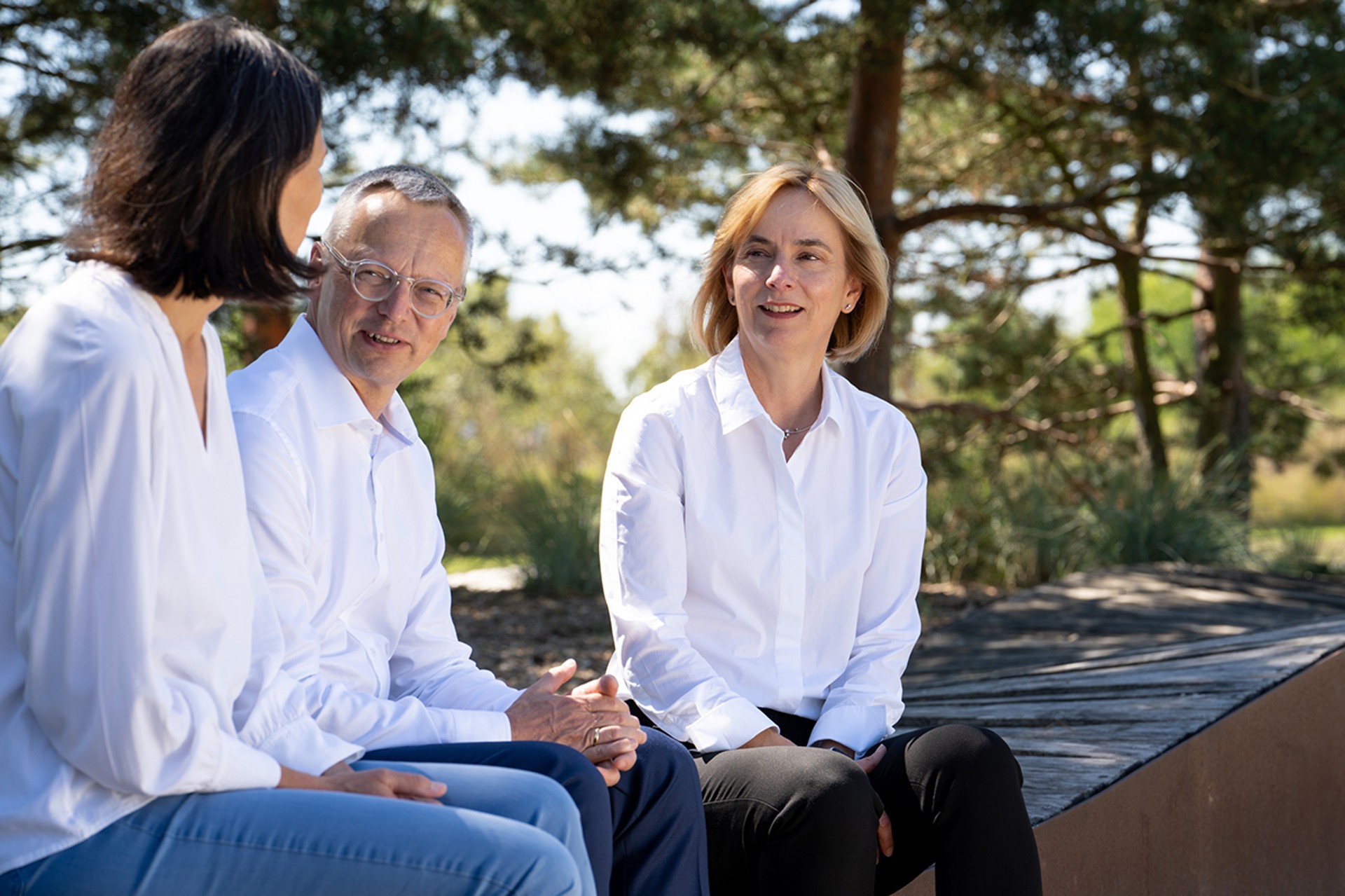
What’s the latest on emissions in our supply chain? Where are we with our products and the Krones sustainability strategy? And what has priority if it comes to the crunch: hitting sales targets or reaching climate goals? A conversation with Martina Birk, Head of Sustainability, Dr Sven Fischer, Head of Research and Development and Caroline Herbst, Head of Sales Marketing.
Krones wants to reduce emissions in the upstream and downstream supply chain by 25 percent by the year 2030. Where are we at the moment?
Birk: In 2022 we had a huge increase in sales, which meant that product-related emissions also turned out higher. Nevertheless, the increase in emissions was only six percent compared with the 34 percent growth in orders received. That's a positive trend, but we’re not yet satisfied with that.
Fischer: The big challenge is that we have committed ourselves to absolute targets in the climate strategy: By 2030 we must be producing 25 percent fewer emissions than we did in 2019 – whatever the growth in sales may be until then. We’re definitely moving in the right direction when it comes to sustainability and have already achieved a great deal. Given the rise in sales, though, that is not enough. We must do much better.
Bringing more products onto the market but producing fewer emissions overall – how can that circle be squared?
Herbst: That's probably one of the questions of the age. At first glance, it is difficult to reconcile further growth and a reduction in greenhouse gas emissions. One of the challenges is that any company can only have a direct influence on a small proportion of total emissions. Krones, for instance, cannot oblige its customers to use green electricity, even though this would have the biggest impact on our Scope 3 emissions. This is something the public need to be aware of.
Birk: Yes, that's a conflict. They can only be reconciled if we improve the energy efficiency of our machines even further – and by more than our growth. I am convinced that we can actually manage this, particularly if we can also factor in the positive variables to a greater extent in the future.
What did you mean by that?
Birk: At the moment many of the improvements that we are making do not get considered in our carbon footprint. That's because we calculate the upstream emissions using what is known as the spend-based method. This multiplies the spending for each material group by the associated emissions factor.
The method has the advantage that it offers a relatively easy way in, since every company produces financial data. For those which are more advanced in their climate strategy, though, it becomes too inaccurate after a while because it uses industry averages, so may not reflect the actual reductions at all.
Fischer: Put very simply, it means that we believe our actual emissions are lower than those we have been reporting to date. That’s why we now need to improve the way we obtain data.
Birk: Yes, and then we will also be able to demonstrate the good things that we are doing. In particular, it means we can also work with our suppliers on more targeted ways to continue bringing emissions down.
Speaking of suppliers, where is there more to do – in the upstream or the downstream supply chain?
Birk: That depends on what you mean by “more to do”. It’s very obvious that the greater savings potential is with downstream emissions – those that are produced when the customer uses our products. Simply because they are much higher than those produced in the upstream supply chain.
Although the great potential is with the customer, though, we are really trying hard on the upstream emissions. That’s partly because we use huge quantities of steel for our products. The Krones Group has undertaken the task of reaching the net-zero emissions target. If that is to be achieved, we will have to buy green steel, but this doesn’t really exist at the moment. That the steel industry is still lagging so far behind with green production is obviously causing us a real headache.
Herbst: There are still few sustainably produced alternatives to our traditional raw materials such as iron and steel, unfortunately. This is where politicians and the industry really need to get their act together.
What is green steel?
The steel industry is one of the world’s biggest emitters of greenhouse gases. Every ton of steel produces about 1.5 tons of CO2, because in nature iron only occurs in oxidized form. To obtain pure iron, iron ore is mixed with coal dust and heated in a blast furnace. At high temperatures the carbon combines with the oxygen from the iron ore, producing CO2.
In the production of green steel, hydrogen is used instead of carbon. The reduction of oxygen produces water rather than CO2. That sounds perfect, but there are two sticking points: For one thing, the technology is still in the experimental stage. It will be a few years yet before it can be applied on an industrial scale. For another, there will not be enough hydrogen in the foreseeable future to meet the needs of steel production. That is because the technology for obtaining hydrogen is also still in its infancy.
How far back in time does Scope 3 actually go? Do lines that were installed ten years ago also affect our current footprint?
Birk: No, the carbon footprint relates to the downstream emissions for machines sold during the financial year – although we want to change that for 2023 – and upstream to sales. Our aim isn’t to have as “good” a footprint as possible in any case, though. We’re more concerned with reducing the actual emissions in our industry on a permanent basis. That’s why, of course, we also need to advise our customers on how they can cut the CO2 emissions produced by the existing lines, such as by installing upgrades or moving to renewable energy sources. Reducing the emissions of our customers is one of our main concerns – even if this does little for our own reporting.
Reducing the emissions of our customers is one of our main concerns – even if this does little for our own reporting.
What about new products: Will there be a shift in the focus of our portfolio? From energy-intensive lines to consulting and digitalization, for instance?
Herbst: Digital products and services are gaining in importance quite regardless of the sustainability issue. And if they are cleverly designed with sustainability in mind, they can also make an important contribution towards reducing emissions in the industry.
Fischer: That’s precisely the point: Digitalization is the most important enabler for making the industry more sustainable – because it gives us the opportunity to solve problems more intelligently and efficiently.
Birk: Of course, it's also clear that before we can offer the relevant digital products and services, we have to be able to sell the machine in the first place. That's where I see a huge opportunity for our energy consulting. I believe that energy concepts will become part and parcel of every line that we supply in the future. Sooner or later we will also bring the issue of energy generation into our line concepts. That means, for example, that we produce refrigeration in advance when there are renewable energy sources such as wind and solar available. These are all new business fields that are really cool from a sustainability point of view and have plenty to offer.
Will we have to say goodbye to some products in favor of climate goals? If so, which?
Birk: That’s a difficult question. Let's take, for example, the comparison between hotfill and aseptic lines. In my eyes everything speaks in favor of the aseptic system: It consumes less energy, and I can use it to fill bottles that are lighter and made of rPET. So why should we offer hotfill at all? With the aseptic system, we have an alternative that is better in every respect. Even so, what do we do with customers who – for whatever reason – don’t want to or are unable to switch over to an aseptic system? Do we send them to our competitors, to a solution that will inevitably be less sustainable than ours?
Herbst: Our aspiration is to supply the most sustainable solutions in the beverage industry, so it wouldn’t help anybody if a customer were to look for a less sustainable solution from a competitor rather than a Krones solution. At the end of the day, there is hardly any solution that would be bad or unsustainable per se. Often there are very good reasons for using a solution that on paper is less sustainable. Hygiene and operability especially often have an important role to play here. A continuously operated line producing higher CO2 emissions can be more sustainable than the lowest-emission solution that constantly breaks down or causes too many faults. We want to enable not only sustainable but also affordable beverages for everyone everywhere – and that, too, is part of our vision.
Fischer: For me, it’s clear that we need to actively manage our portfolio. The argument that “it’s what the customer wants” doesn’t cut it for me. Our new technologies need to be so persuasive that customers use them to achieve their own sustainability goals. If we were now to start making our current PET line fit for hotfilling, that would be an investment in the past. Even just on the basis of the low number of pieces that we sell in the hotfilling segment in the first place. For most customers aseptic is the technology of choice. If we spend millions on developing a worse alternative, we will be sending absolutely the wrong signal to the market.
How great is the pressure on Research and Development in this regard?
Birk: Very great, I put pressure on them almost every day (laughs). Seriously, though, the enviro sustainability program has been a fixed part of our product creation process since as far back as 2008, and it's now part of our developers’ DNA. It's incredibly enjoyable watching how everyone always wants to achieve more and gives each other ideas. Even so, here too there are different aspects to consider: After all, we only have limited resources to work with in development. Wouldn’t it be better, then, to concentrate only on the big innovations? What I say is that every little bit helps. And if a small improvement can be achieved relatively easily, why shouldn’t we go for it?
Fischer: I see it rather differently. If I am faced with the choice of putting my limited resources into small, moderate or big improvements, I would always opt for the big ones where I achieve real progress. Given that time especially is in short supply, we shouldn’t be getting bogged down in the little things.
We also need to keep an eye on what our main product is, which is the line. 85 percent of our machines are delivered as a line or part of a line. That's what we have to focus on – identifying and improving the biggest consumers at line level. In autumn last year we promised the market that Krones would present the sustainable line of the future at drinktec 2025. That is what we have to concentrate on now. And that is also what will give us the head start that we need for the future.
Every company is simply one of many components in a complex value chain. Isolated changes aren’t going to achieve anything. Climate protection is a shared project – only if we all work together will we get it done.
How willing are our customers to do their bit in meeting the 1.5-degree target of the Paris Climate Agreement?
Herbst: Enormously. While a shift isn’t going to be achieved overnight, many of our customers feel an obligation towards the 1.5-degree target and are developing strategies for meeting the requirements in the medium term and already taking steps today.
Birk: It wouldn’t work any other way. Every company is simply one of many components in a complex value chain. Isolated changes aren’t going to achieve anything. Climate protection is a shared project – only if we all work together will we get it done.
Are there regional or industry-specific differences here?
Herbst: International companies, which the media tend to focus on more, are already very specific about their goals and how these are to be reached. But more and more small and medium-sized enterprises have also been getting actively involved in limiting their CO2 emissions. There are also regional differences, of course, but there isn’t any one single approach being taken by all companies in a particular region.

What responsibility does Sales have here when it comes to getting customers interested in sustainable technologies?
Herbst: As the direct interface, Sales has a particular responsibility to persuade our customers that sustainable products will have a positive impact not only on the environment, but also on them. This is where even more work on persuading customers is required at the moment, because unfortunately it frequently entails greater investment. Even so, in many cases this pays off sooner through energy savings and hence lower running costs than people might at first think.
In the majority of cases the return on investment is the decisive criterion for capital spending. In other words, how quickly will choosing the most sustainable variant pay for itself? This is where Technology especially needs to supply Sales with the right arguments. Customers are persuaded by arguments that can be backed up with facts, figures and data.
After a decade of debate, we are now finally a step further. We should all know what needs to be done and can get our act together.

Would we also be willing to lose customers in favor of our climate goals?
Herbst: This isn’t a black and white situation. Customers aren't lost because solutions are “too sustainable”, but not every customer can afford a higher price. That’s why we need to move in the medium term from “dearer but sustainable” towards “the same price or even cheaper but also sustainable”.
Birk: Hopefully societal change will continue until 2030. At some point the pressure will become so great – whether from the financial markets, consumers or governments – that missing CO2 targets will really hurt the bottom line too.
Fischer: In many large companies – and also at Krones – sustainability has now been incentivized, which means that its progress has a direct impact on pay. That means people have a personal interest in achieving the reduction targets. The increasing pressure from the financial markets is adding to that. After a decade of debate, we are now finally a step further. We should all know what needs to be done and can get our act together.
Where are we by comparison with our competitors?
Herbst: In many areas Krones already has a very high market share, but our competitors are not sleeping. First and foremost it’s about not losing share. If we manage to bring better solutions onto the market sooner, we can even gain more share. In the future, it could be “If you’re looking for sustainable solutions, then go for Krones” or, as it says in our target picture, “Krones – Solutions beyond tomorrow”. And a race towards greater sustainability – which hopefully Krones will continue to lead in the future – is ultimately a win-win for everyone.
Fischer: “Getting better sooner” is exactly what it's about now. At the end of the day, we want to be an example for the industry, and we have committed ourselves to that in our target picture.
We value your opinion!
Feel free to join in our discussion on LinkedIn
Do you have any questions? Or would you like to share your thoughts on this subject with us? We welcome you to post your comments and remarks!
Hier geht's zum LinkedIn-Post(opens external link in a new tab)