

 Julia Leserer
“Direct heating is gentler on my product thanks to its short heat-holding phase, but it uses considerably more energy than indirect heating.” This is a common preconception, but it doesn’t apply to the direct heating process from Krones. That’s because Krones’ process technology team has developed an innovative, holistic energy concept for the VarioAsept D that makes it possible to capture and intelligently reuse surplus thermal energy from direct heating – and significantly reduce energy consumption.
Choosing a suitable process for product heating is not always easy. Preference is often given to indirect heating because it entails a smaller initial investment and allows for energy recovery. However, heating the product, keeping it hot and then cooling it down again takes far longer – and the resulting thermal stress can affect the product and its taste.
The gentler alternative is direct heating, which is particularly well suited for highly sensitive products like plant-based milk alternatives and milk-based drinks. That’s because the entire process of heating up and cooling down the product takes only a few seconds. So, it’s certainly gentle on products. But it isn’t exactly energy efficient, because it takes quite a lot of energy to bring a product up from 80 to 140 degrees Celsius in a matter of mere seconds. Now, Krones has addressed this shortcoming – and successfully at that.
Process innovation: high-gravity heating
Of course, the idea of combining energy recovery with direct heating is not entirely new. However, many approaches fail because the heat coming off the cooling process is simply not hot enough. But Krones knows that direct heating offers plenty of potential for energy optimization – and has proven it with a holistic energy recovery concept.
In developing this system, the process technology team has revolutionized the heart of the VarioAsept D, that is, the direct-heating process itself. Taking a cue from high-gravity brewing, which has proven itself in the field of beer brewing, Krones has introduced what it calls high-gravity heating, in which the product (oat drink or a dairy-based drink) is fed into the direct-heating system in a highly concentrated form. That means the water content of the beverage at this point is lower than that of the finished product.
The genius of heating a concentrated product in this way becomes apparent when we look at the cooling process. That’s because, in order to arrive at the desired finished product, a conventional direct-heating process will remove the same amount of steam that was injected or infused into the product during heating. Since the high-gravity approach involves adding water to a concentrated product in a later stage, Krones solves the problem by simply leaving a predefined amount of the steam in the product during cooling.
Advantages of the concept
The benefits to be had as a result of this modified process are readily apparent at various points:
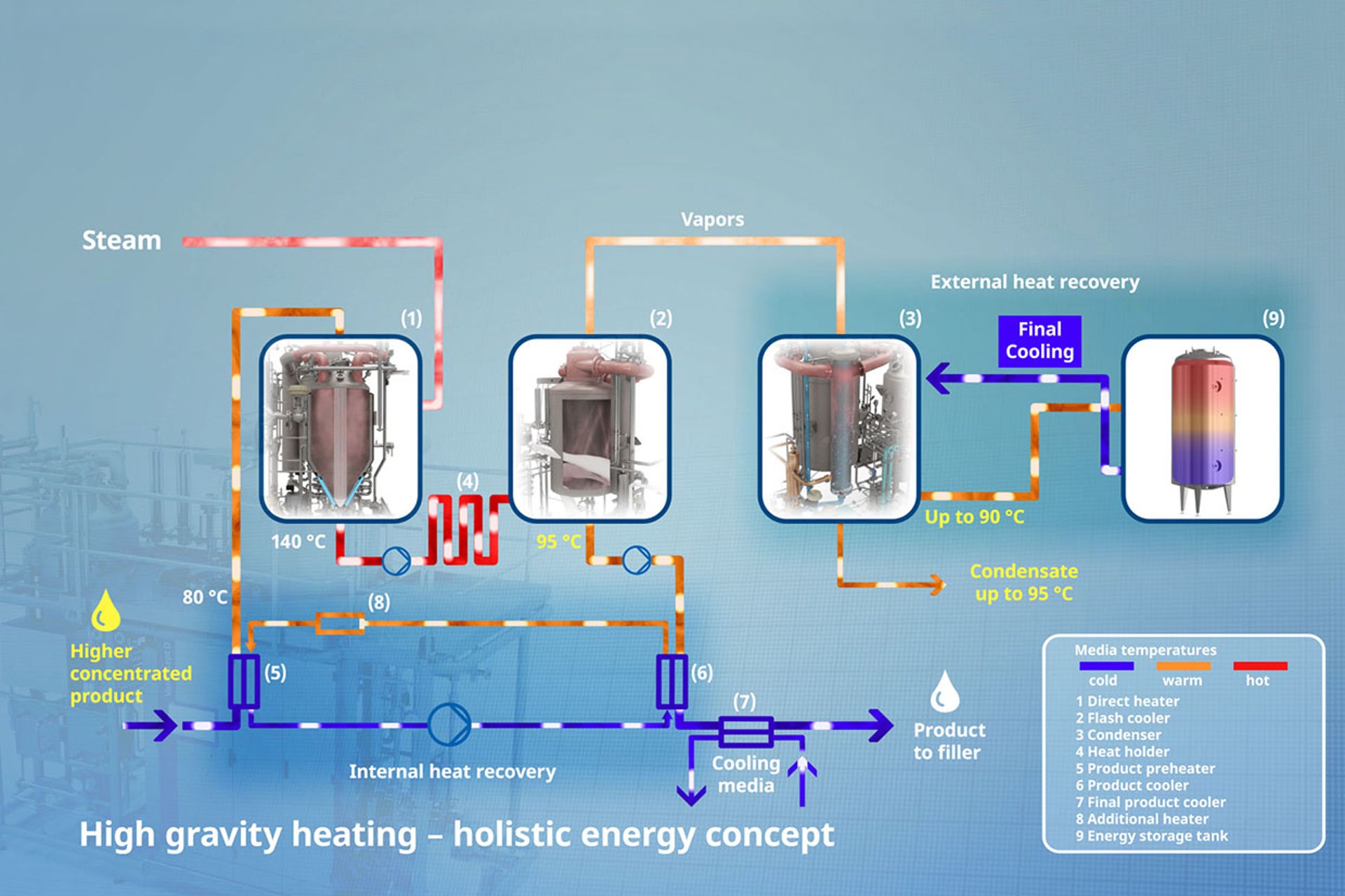
Holistic energy concept for direct heating
The energy concept is impressive thanks to its well-thought-out processes and synergies, which considerably reduce energy consumption. “We have been able to optimize proven processes and thus cleverly recycle existing energy flows,” explains Dr. Thomas Oehmichen of Krones’ product development team for units and components. “We’re thinking outside the box here – that is, beyond the VarioAsept D direct-heating system itself – by using the cooling water that’s up to 15 degrees Celsius hotter now for mashing. This holistic approach enables us to optimize energy use across the entire process of oat drink or dairy drink production.”
Capitalizing on synergies from the brewing industry
With this holistic energy concept for direct heating, Krones is once again demonstrating its process technology expertise – and showing how synergies can be cleverly combined for maximum effect. The concept of collecting primary energy in the form of steam and extracting it from the flash cooler in the form of condensate for further use is based on the EquiTherm energy recovery system, which was originally developed for breweries. This current application of direct steam injection offers a sensible way to harness this energy for the production of oat milk, using the recovered warm water for the hydrolysis process or even as a heat transfer medium in our pillow plates.
In developing the concept, the teams from Krones and Steinecker(opens external link in a new tab) worked together closely and have shown how energy-saving concepts that have long since become established in the brewing industry can also be applied in the liquid-food sector. It’s an example of how, through collaboration across the group, we are able to adapt our holistic, sustainable energy concepts for new markets.
Beverage and liquid food companies also benefit from this innovative vigor. Because, thanks to this energy-efficiency concept, they are able to reduce the amount of energy needed to make their products – and, in the bargain, to actively contribute to rendering their entire production operation more sustainable.
We value your opinion!
Your opinion matters to us!
To get to know our readers better and to tailor the content of Krones magazine even more closely to their interests, we have created a short survey. We invite you to take a few minutes to answer some brief questions. Thank you!
Hier geht's zur Umfrage(opens external link in a new tab)