

 Julia Leserer
No two waters are alike. As with almost everything, it’s the small details that make the difference. And for water, they are so small that genuine experts are required who can detect even the tiniest of sensory differences between the various mineral waters available. Five Krones colleagues completed a water sommelier training programme, which has taught them to develop precisely that ability, enabling them to advise our customers to better effect.
Beer, wine, whisk(e)y – tastings have become quite popular for alcoholic beverages. But have you ever taken part in a water tasting? Almost certainly not, because most people pay little or no attention to the mineral water they are drinking.
However, we’re actually doing water an injustice because it does in fact have many facets: “Its taste changes depending on its mineral composition. A lot of calcium gives you a furred tongue, magnesium tastes sweetish in weak concentrations but bitter in high concentrations, and the trace element silicate makes for a full-bodied taste experience,” explains Jörg Berger, who is in charge of the sales team for water treatment systems. And he knows exactly what he’s talking about because the graduate chemical engineer, in addition to the usual tasks entailed by his job, also functions as a water sommelier. He is one of five working for Krones who completed his training at the Doemens Academy in March 2022 together with his two sales colleagues Martin Rominger and Maximilian Keil, and with Florian Köglmeier from Process Technology and Maximilian Frammelsberger from KIC Krones.
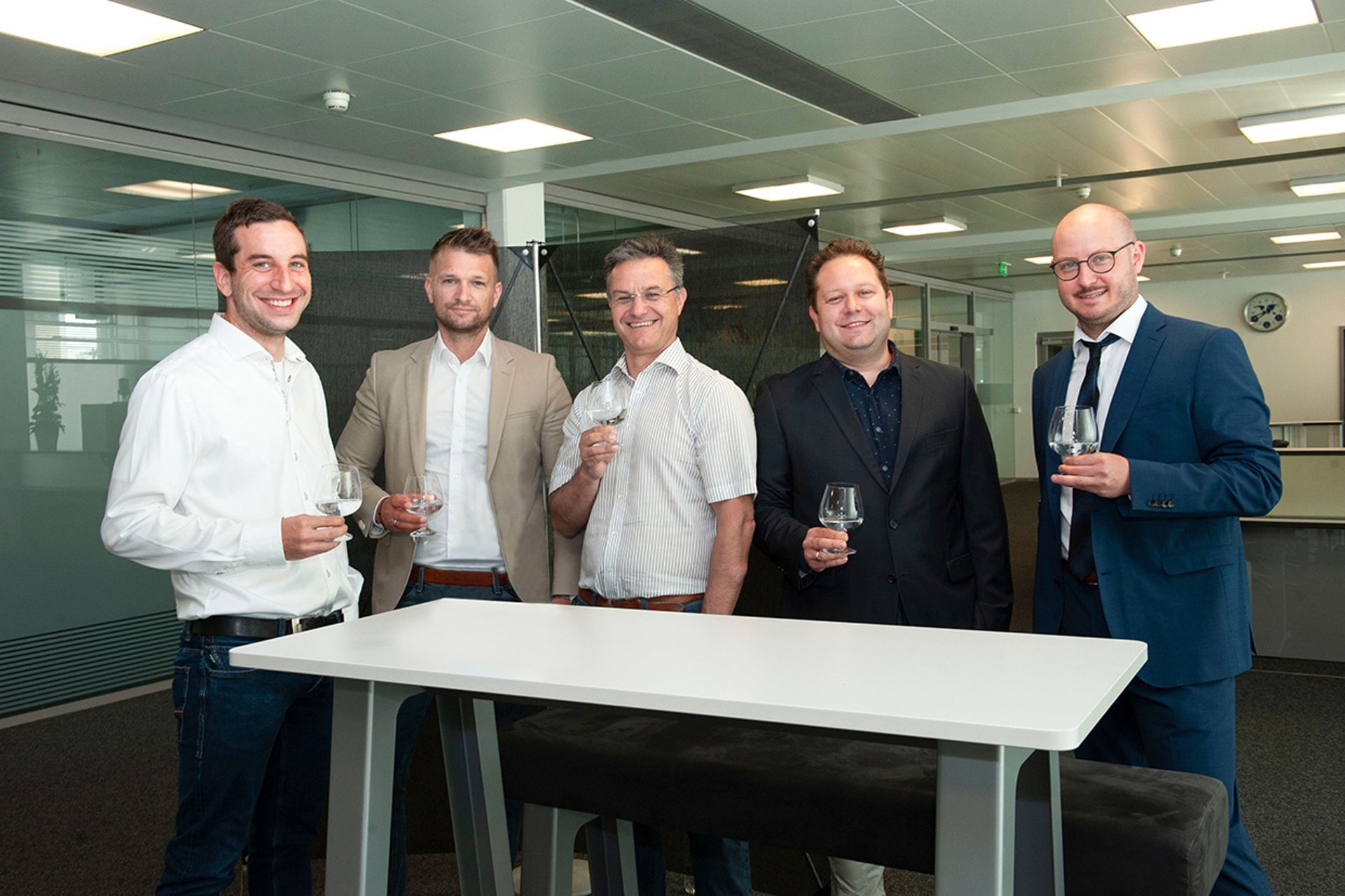
Wanted: Special instinct for sensory nuances
The requisite two-week course at the Doemens Academy is unique worldwide because there is probably no other training programme of comparable length that goes into such detail or offers such exacting tasting training sessions. The course was most definitely in a class of its own, especially the practical part of it: “We started by training our taste buds to detect tastes like salty, bitter, sweet and sour. We then put what we had just learned to good use on various mineral waters, identifying their constituents,” says Maximilian Frammelsberger. “Both theoretically and practically, we were taught all about the minerals and salts found in water, and how they affect its taste.”
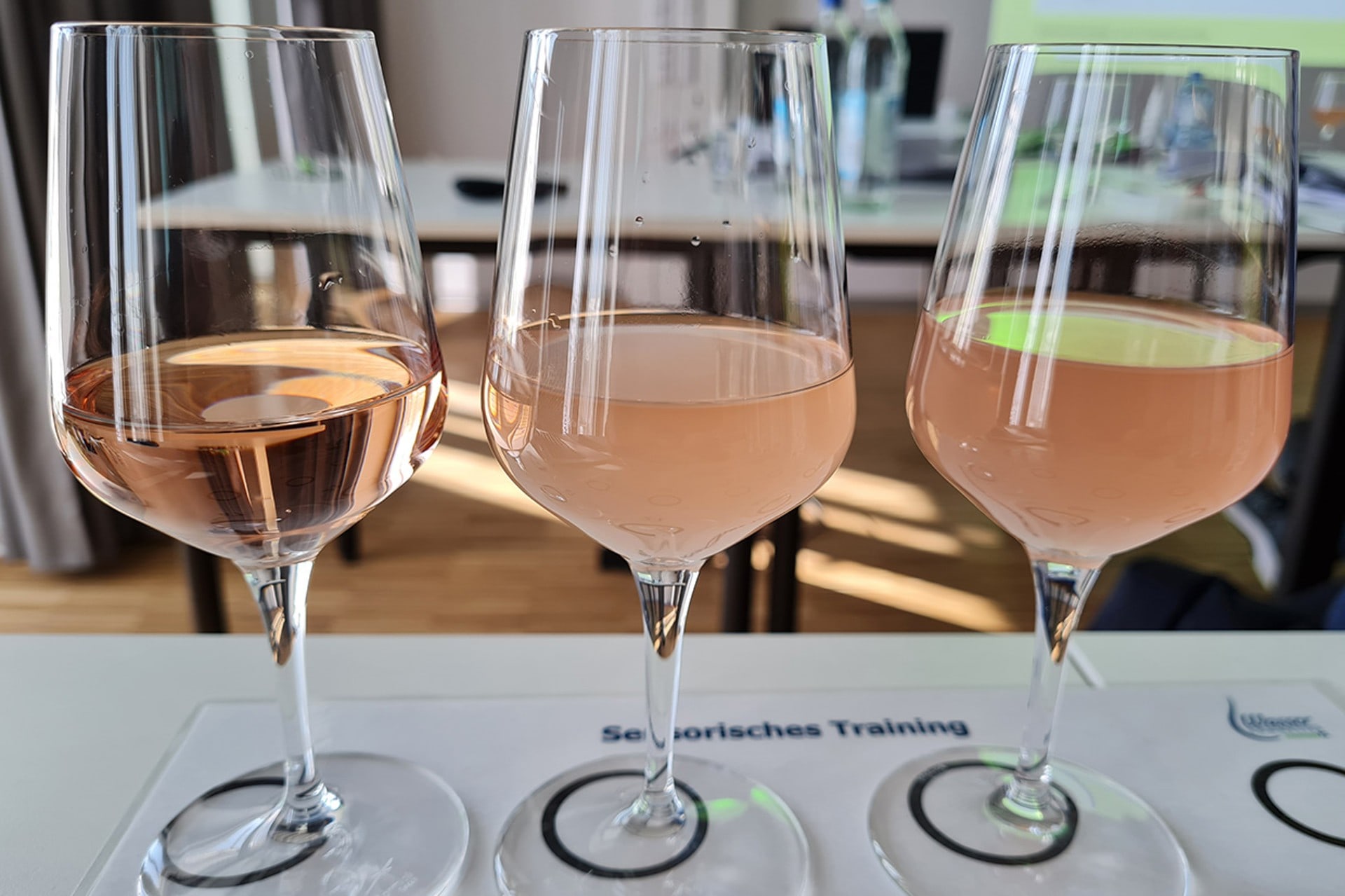
In retrospect, the course proved highly intensive and was extremely demanding. To quote Jörg Berger: “To be honest, when we started I found it hard to imagine that we’d be able to take a comprehensive exam after just two short weeks. But an incessant stream of tastings, in which we sampled the most varied range of mineral waters, and the in-depth explanations given by our lecturer which were based on sound scientific data helped us understand it all. We soon found ourselves detecting even the tiniest taste differences, describing them and internalising the effects that individual minerals and trace elements have on a water’s taste and our perception of it.”
The exam combined theory – a water’s numerous ingredients and their nutritionally important aspects – and practice: In several tasting sessions, the participants had to identify minerals like magnesium, calcium, etc. in the water they drank. But that was not all. They also had to detect certain mineral compositions and assign them to individual mineral waters. Waters with different carbonation levels were also part of the exam. The participants had to line them up in the correct sequence in a blind tasting. “Yet another task was to draw up a water list, similar to a wine list you get in restaurants. Based on various mineral water brands, we described their mineral content, origin or taste, and gave appropriate recommendations,” says Maximilian Frammelsberger.
The goal: To assist customers with expert knowledge
The idea of taking this training course was born during joint customer projects. The water market is booming, and there is a similarly steep rise in demand for new water treatment systems. “It’s above all in regions where a lot of water is consumed due to extreme heat or a ban on alcohol that large numbers of different mineral water brands can be found,” says Maximilian Keil.
And since more and more people have recently developed a heightened awareness of the importance of a healthy diet, the five colleagues decided to gain more in-depth knowledge on the subject of water. Martin Rominger sums up: “For us in sales and marketing, it’s incredibly important to be able to draw upon this huge fund of expertise, so we can give customers comprehensive, professional advice right from the start. But it is equally essential for our staff working in technical departments to know more about water as a product, so they can choose optimally matched systems and minerals.”
Why is “Water Design” necessary?
Accounting for a share of over one-fifth of the worldwide beverage market, packaged water is the clear Number One in the list of top global beverages – with no sign of any let-up in the trend. At first glance, mineral water might be expected to have the least exacting requirements in terms of its production process. But when you look at the ingredients of various brands, you quickly realise that exactly the opposite is true. Minerals, in particular, must be added more and more frequently. The reasons for this are many and varied.
Increasing pollution of our natural environment does not stop at raw water, which also loses all minerals during the intensive yet indispensable treatment process. So these minerals must be added back during the conditioning phase.
The market is yet another driver of water-brand proliferation. This is because consumers, either for health-related reasons or because of their personal lifestyle (age, gender, origin), increasingly opt for fresh and maximally natural products which contain no ingredients that might be harmful to their body (like sugar, for example) and which have been fortified with substances held to benefit their health, like silicates, magnesium, electrolytes or collagen. Producers respond to these wishes by creating specifically matched water formulas in order to directly target the different groups.
But water pure and simple is not just the world’s most important staple, it is also the main ingredient of most other beverage categories like CSDs, all alcoholic beverages and plant-based drinks. And for all of these, impeccable raw-water quality is, of course, a basic prerequisite for making top-notch products.
Water Design from Krones
So, since passing their exam to qualify as water sommeliers, the five colleagues have no longer only been working in sales or the technical departments but have also been playing their part in a new product: Krones has of late been offering water companies a full-service package entitled Water Design. It starts with developing the water formulation, then suitable system configurations, and also includes accurately matched minerals and consumables from KIC Krones(opens external link in a new tab) required for ongoing production.
It’s in the first phase – developing the water formulation – when the five water sommeliers come into play. Over the past few months, they have been able to put their freshly acquired knowledge to good use: “There was one customer, for example, who wanted to produce his water to the same high quality at a different facility. So we first analysed the product in question, tasted it and then tried to create an exact twin in our pilot plant. For this, we used water that was first fully demineralised in a reverse-osmosis process and then remineralised,” says Florian Köglmeier, looking back.
The best example of the Krones water sommeliers’ work is, of course, the development of a completely new formula where selectively targeted remineralisation is used to create a water with quite specific taste nuances or ingredients. This is the ideal solution for new entrants in the water business and also for those who want to surprise the market with fresh types of mineral water. But beverage producers who already have a formula for their water can likewise get in touch with Krones because detailed tastings will familiarise the Krones team with the customer’s product and enable them to select the new system technology for an optimum match.
In-house pilot plant for water trials
A dedicated water pilot plant has been running at Krones headquarters in Neutraubling since early 2022, allowing the water experts to perform the requisite tests and trials. It includes a Hydronomic module for reverse osmosis, plus two other systems: an EDI module where a water’s mineral content is reduced to a minimum by means of electrodeionisation. The result is ultra-pure, deionised water: the ideal basis for adding back the desired minerals. In a second module, electrodialysis is used to create water with a silicate content, without simultaneously increasing its sodium content.
All the requisite minerals and other additives needed to selectively reproduce the composition of waters with different formulas and taste nuances are, of course, available in the water pilot plant.
“So in our pilot plant we’ve got all that’s needed to conduct even extensive tests and develop water formulas. For more detailed, independent water analyses, we also cooperate with third-party laboratories,” explains Florian Köglmeier.
Although he and his four colleagues are dealing with the subject of water on a permanent basis, they do not spend every day in the pilot plant tasting various waters. In order not to lose their touch though, they meet up regularly to train their taste buds, since “Practice makes perfect” certainly also applies to water sommeliers.
We value your opinion!
Feel free to join in our discussion on LinkedIn
Do you have any questions? Or would you like to share your thoughts on this subject with us? We welcome you to post your comments and remarks!
Hier geht's zum LinkedIn-Post(opens external link in a new tab)