 Markus Stettner
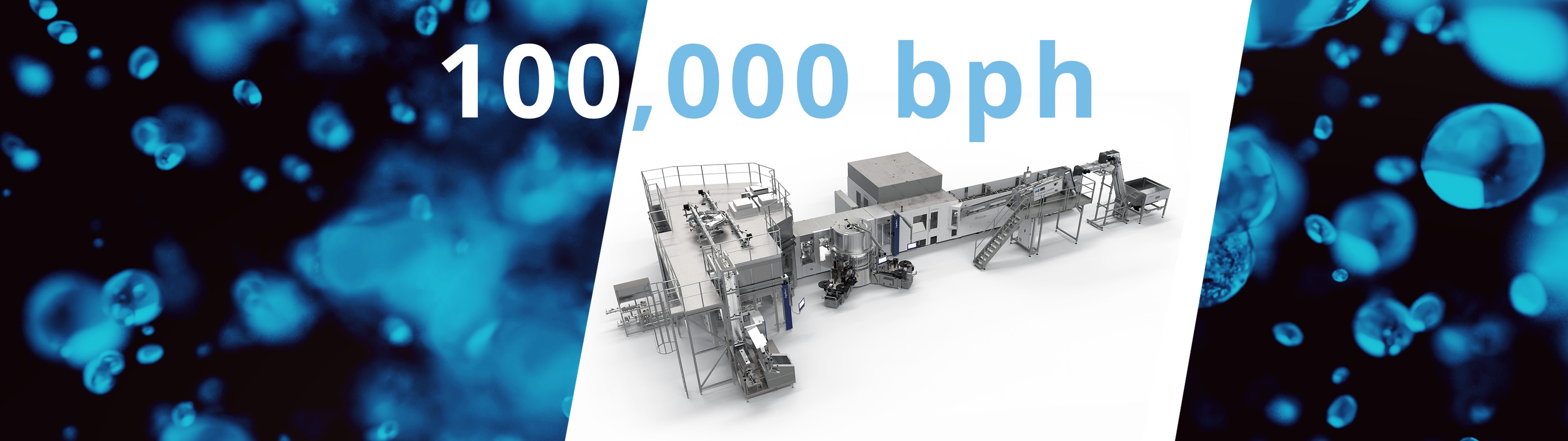
With the development of the 100,000-bph ErgoBloc L, Krones has set a new standard in block technology. The US-based beverage maker Niagara Bottling, LLC is the first company in the world to put this groundbreaking filling technology into operation. We spoke with Niagara Bottling to learn why the company chose the 100,000-bph ErgoBloc L.
In order to meet the rising demand for packaged water, filling companies need appropriate machine speeds. Contrary to commonly held opinion, a single larger line offers better performance in terms of both energy and media consumption per packaged unit than multiple medium-output lines. Krones’ response to this development is the world’s first wet-end block achieving an output of 100,000 0.5-liter water bottles per hour – thus establishing a new benchmark in block technology.
The basic production sequence of this 100,000-bph block is just the same as in a conventional ErgoBloc L. But a closer look at the individual machines reveals some key differences. The filler posed the biggest challenge for the development team because there are physical limits to the standard approach of “bigger carousel equals higher output”. At some point, the masses to be moved and the forces acting on them simply get too big to reliably maintain a stable process. In order to prevent this, the block features two modularized filling units and two modularized closing units.
Two filling units, two closing units – but only one machine
That may sound simple, but was in fact difficult to implement because although the filling/closing of 100,000 bottles per hour is evenly distributed among two units each, these units are still constituent parts of a single integrated block with just one valve rack and one sorting system for closures. The Modulfill Dual features around 60 filling valves fewer than a one-filler solution would need for the same output. Thanks to its compact size, the filler takes up less space, but its output is still almost 20 percent higher.
And Krones has packed even more innovations into the high-speed block: For example, some components from the fourth Contiform generation are used in this high-performance block, such as the newly developed skip-and-run technology, which monitors the mold-hanger locking device and allows a blowing station that is not locked to pass along the main cam, for instance to eject a defective preform without triggering an emergency stop of the entire machine. That considerably reduces the scrap rate and eliminates the need for operator intervention.
In addition, Krones has developed Contiloop AI, an automatic process control system, and put it to use in the new Contiform: The combination of AI-based software and newly developed hardware makes it possible to detect even the slightest variations in material distribution in the production of PET containers and to automatically adjust key stretch-blow-molding parameters in real time – and thus to ensure that bottle quality meets specifications. This factor is particularly important when working with rPET.
The link between stretch blow-molder and filler: the Ergomodul
In developing the stretch blow-molder, Krones focused on enabling operation that is eco-friendly, sustainable and at the same time cost effective. By shortening the distance between the heaters, they’ve made the heating space even more compact overall and redesigned the heaters with parabolic reflectors. As a result, they’ve cut energy consumption by 11 percent compared to the previous generation. The team has also achieved substantial savings on compressed air. Unlike the technology customary on the market to date, the new Air Wizard Triple air recycling system uses a three-stage compressed-air recycling process that can reduce compressed air consumption by as much as 20 percent.
To cope with the very high output of the stretch blow-molder, some additional, optimized components, functionalities and assemblies were incorporated in the Ergomodul. For example, the two Contiroll labeling stations and the Multireel magazines for label reels feature a new buffer system which keeps the label tension at a constant level, thus offering ideal preconditions for thin label films, a boon for sustainability.
Another of the machine’s key features is the “no bottle – no label” function. If a service rejection in the blow-molder causes a gap in the bottle flow entering the labeler, no label is transferred to the vacuum cylinder and the corresponding vacuum cylinder suction bars are retracted upon reaching the gluing unit. As a result, no label or glue is wasted and any gaps in the container flow no longer affect the efficiency of the line.
Read the interview with Niagara on the next page.
100th Line Management system in the USA goes to Niagara
Since 2011, Niagara has put its trust in Krones’ Line Management, a digital solution for optimum planning and parameterization of filling lines. And now, the 100th system has been sold to the USA – and it is going to Niagara.
Line Management takes care of communicative and monitoring tasks and is therefore especially well-suited for manufacturing processes that involve frequent batch changes and a variety of products and pack types. As a result, fewer manual interventions are needed and all orders in the filling and packaging area are coordinated centrally – from the definition of production routes to the labelling of pallets. By ensuring that all materials are always requested at the right time, the system saves on production costs and increases efficiency all at the same time. “With Line Management, we save the cost equivalent of a small car every day,” says Bill Hall, Executive Vice President of Manufacturing and Engineering at Niagara.
“The ErgoBloc L, at 100,000 bph, represents the next step forward in Niagara and Krones’ relentless pursuit of low-cost leadership and high output rates.”

In our interview with Niagara leadership, Alan Bunteman, Vice President of Engineering, and Julia Buchanan, Vice President of Marketing and Communications, tell of their first experiences with the new ErgoBloc L at Niagara’s facilities in Hazleton, Pennsylvania, and Baytown, Texas, and of the importance of sustainability to Niagara.
Can you please tell us a bit about your company?
Julia Buchanan: Niagara Bottling has been family owned and operated since 1963. We’re incredibly proud of our family heritage and reinvestment back into the business. We believe that investing early in automation and technology has allowed us to scale and grow as a low-cost manufacturer. We now operate over 50 bottling facilities throughout the US and Mexico. We serve some of the largest beverage brands, retailers, grocers, club and convenience stores throughout the country. We’ve also expanded our footprint to include bottled water, sparkling, vitamin and flavored water, teas, sports drinks, ready-to-drink coffee, protein drinks and non-dairy milk products. To say we have a lot going on is an understatement! We’ve been fortunate to have great partners supporting our growth and vision along the way!
Which types of products are you filling on the new Krones lines in Hazleton and Baytown and in which types of bottles?
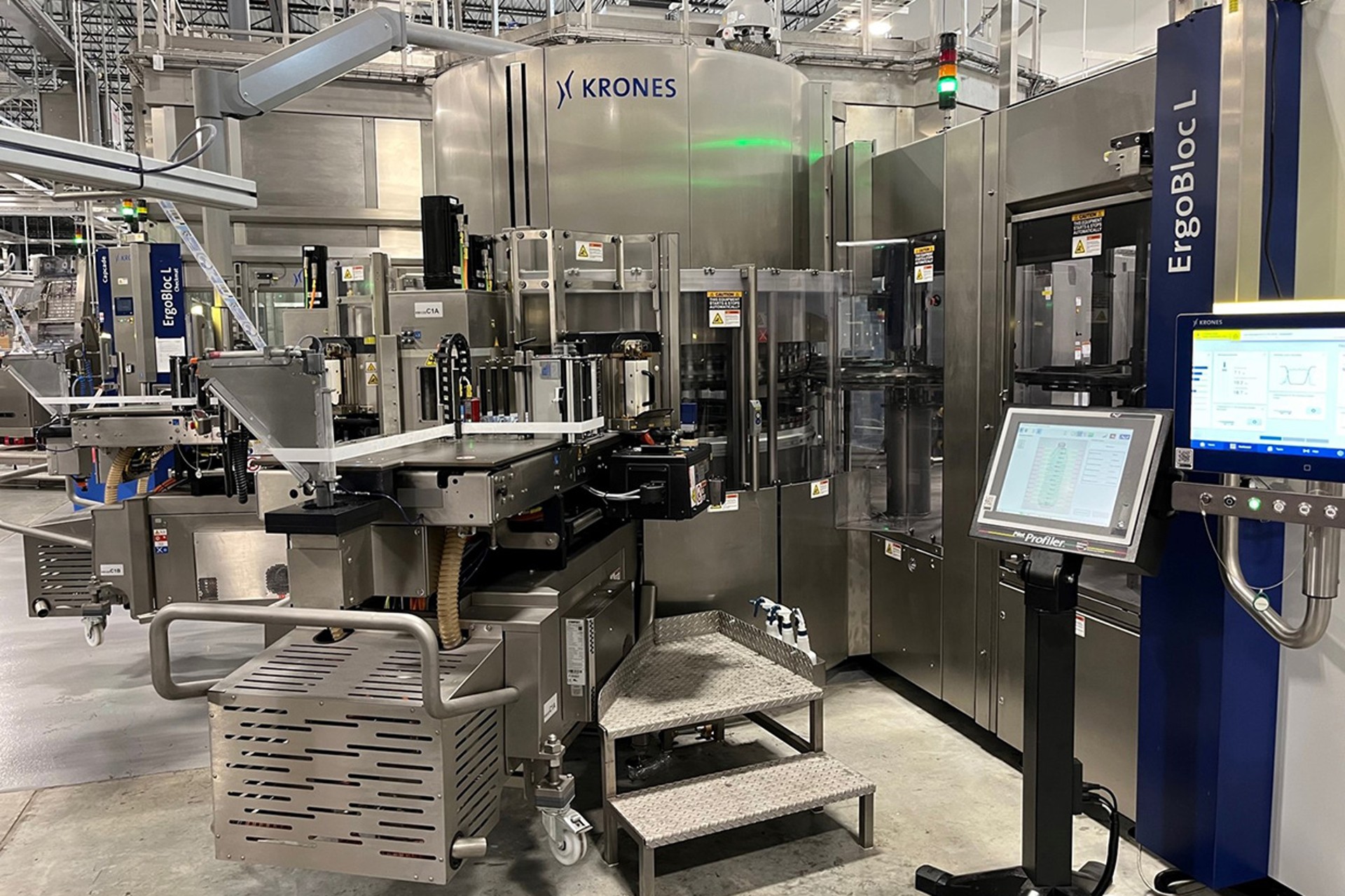
Alan Bunteman: We are currently producing our core half-liter bottled water products in our Baytown, Texas, facility. These lines are the fastest single block lines in the world. We run a variety of pack sizes including 24 and 40 pack cases. In our Hazleton, Pennsylvania, site we run a variety of products including our core half-liter bottle water products, hot-fill beverage products and later in 2023 high-acid aseptic products.
Why did you choose the ErgoBloc L with an output of 100,000 bph?
Alan Bunteman: The ErgoBloc platform has been a high-performing asset within Niagara Bottling’s portfolio for many years. The ErgoBloc L at 100,000 bph represents the next step forward in Niagara and Krones’ relentless pursuit of low-cost leadership and high output rates. A single block design that can produce 100,000 bph was an obvious next step in the evolution of Niagara Bottling’s manufacturing evolution.
What do you appreciate most about the new ErgoBloc L? How does it support your production?
Alan Bunteman: Speed. With high quality and a safe design assumed, the high output rate of the ErgoBloc L affords the platform the ability for high output with low resource consumption and low floor footprint. While Niagara Bottling is focused on our half-liter bottle offerings, the ErgoBloc L is versatile enough to run other bottle formats as well, such as 8 ounces.
Did you have the sustainability aspect in mind, as well, when choosing the new lines?
Julia Buchanan: Sustainability is at the forefront of everything we do. We are committed to responsible resource usage and reducing our impact through water stewardship, packaging innovation and carbon footprint reduction. We’ve been focused on packaging reduction and bottle lightweighting since the early days. We’re fortunate to have been in a position of really pushing the envelope when it comes to bottle design and helping drive the industry toward lower weight bottles.
We value your opinion!
Feel free to join in our discussion on LinkedIn
Do you have any questions? Or would you like to share your thoughts on this subject with us? We welcome you to post your comments and remarks!
Hier geht's zum LinkedIn-Post(opens external link in a new tab)