Close
Search
Searching...
No results
    Backstage

    “We’ve never regretted anything”

    You need to accept cookies to use this functionality.
    25. June 2026
    10:55 min.

    Have there been any ideas whose benefits customers didn’t understand?

    Kronseder: Yes, direct printing is one such example. It’s the concept in which the label is printed directly onto the bottle digitally. Right across Europe, many manufacturers of household or cosmetic products especially operate from a single central factory, so they need to stock printed bottles in a lot of regional versions. With direct printing you would have a blank bottle that could also allow customised printing for special sales campaigns. Despite these benefits, and even though customers gave us a lot of encouragement in the development process, very few of the DecoType machines were sold. That still surprises me today. 

    And what about ideas that ultimately failed to make it?  

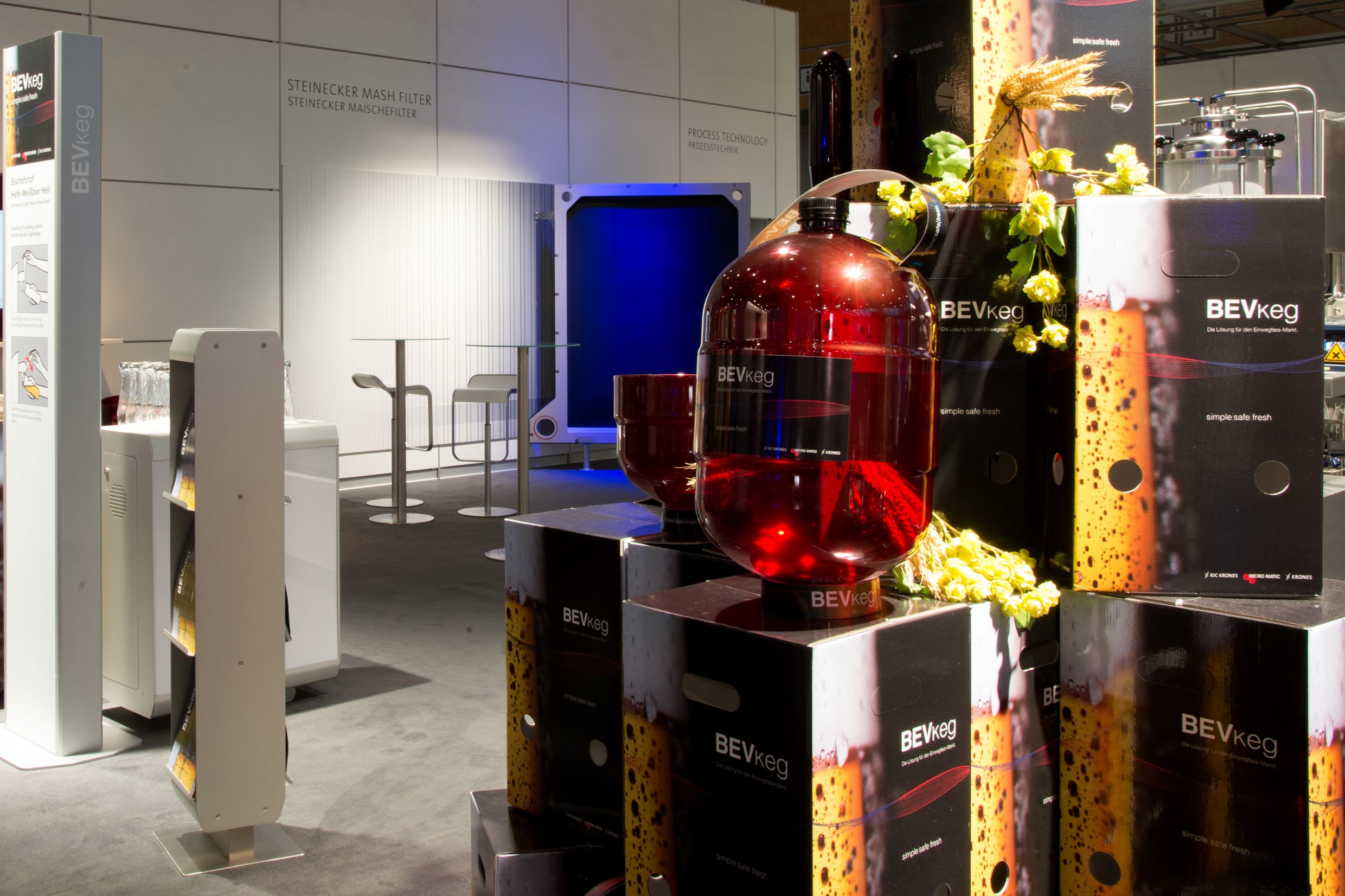
    Kronseder: BEVkeg was one of them. When beer is poured from kegs – which are metal beer barrels – CO2 is injected so that the beer flows out from the top. A Krones developer at the time came up with the idea of doing this without CO2 – and in a non-returnable PET container. During pouring, this so-called BEVkeg was then pressed from below using a plunger, causing it to compress elastically. The development effort was quite considerable, and the idea also met with considerable interest from experts. However, it was unable to break through as an alternative to traditional pouring systems, so after a few marketing attempts, we put the whole thing on ice.  
    Do you remember good ideas that were never turned into reality?

    Kronseder: I was always a fan of lightweighting – not only for bottles, but also for machine parts, for instance, because it makes life a little easier for operators when converting a labeller. We experimented for a long time with superlight grippers, shafts etc. made from carbon fibre. In the end, though, it didn’t work out for cost reasons. 

    To what extent do customers drive innovation? 

    Wahl: A good example is the lightweight bottle for non-carbonated water. For anyone filling billions of bottles, even just 0.5 grams less PET per preform will pay off. It was not trivial to reduce the weight of the preforms that much and process the unstable bottle on the line. Another challenge was palletising without the bottom layer of a fully loaded pallet buckling. That was really driven by a US customer. We then became the pioneers in lightweight bottles, which gave us a competitive advantage when dealing with other customers.   

    Kronseder: Another example is the 100,000-bph PET line. The same customer insisted they wanted to get a single 100,000-bph line instead of two 50,000-bph lines. Developing such an ErgoBloc was extremely challenging, but we’re now also selling this solution to other customers. 

    On the block idea, industry experts were very sceptical that it would work, but the technology is still successful today. Are there any similar examples?  

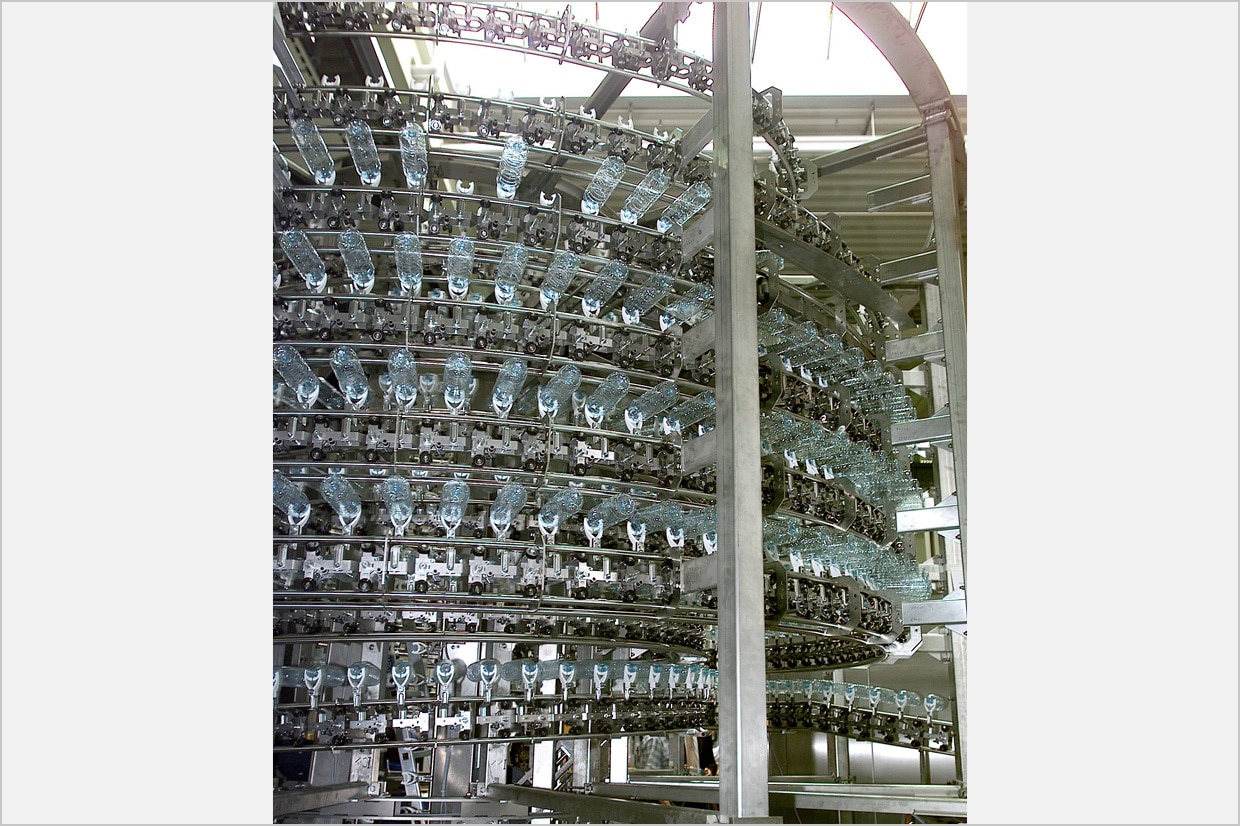
    Kronseder: The Acculink and the Accutower. They were dynamic buffer elements between the blow moulder and the filler and between the filler and the labeller respectively. In contrast to traditional buffer systems, they conveyed the containers on a vertical spiral rather than on a horizontal track. It was a crazy design and everyone said it would never work. Somehow we managed it, though, and sold a couple of the systems. The development of the ErgoBloc made this sort of buffer obsolete, however.

    Acculink D757_26
    “A crazy design”: The Acculink buffer system transported bottles on a spiral track.

    What current developments do you think point the way for the future?

    Kronseder: The integration of the Prefero, the PET injection moulder, into the line. The preforms are injected at about 200 degrees Celsius, so they are still sterile. If you transfer them into the blow moulder in this same state, that removes the need to sterilise the preforms. And even if you don’t manage to maintain a sterile environment at first, you’ll still save energy. Normally the whole preform is cooled down. In an integrated process you only need to cool the thread down and can use the residual heat of the preform for stretch blow moulding. If we were then to feed the recycled PET flakes directly into the injection moulder without first transforming them into granules with the application of energy, as is currently the case, we would only have one heating process rather than the three we have today.  

    Wahl: Another big step forward is the Ingeniq. All the available status data of a bottling line is now transferred to us, so we always have an overview of what is happening. That enables us to guarantee the customer a certain output and efficiency. And we help them improve the line by analysing the collected data and identifying particular areas where we can enhance efficiency still further. Ingeniq offers important progress for our customers, particularly those with high-performance lines. 

    How is Krones doing in terms of patents? 

    Wahl: According to the statistics of the German Patent Office, Krones has regularly ranked among the top 30 German companies in recent years and at the top of the mechanical engineering sector. In 2025, we submitted more than 300 patent applications to the Office and recorded almost 600 internal invention disclosures, which is a record for us. 

    Is there a patent that has most annoyed the competition? 

    Both simultaneously: The high-performance labelling station! 

    In 2025, we submitted more than 300 patent applications to the German Patent Office and recorded almost 600 internal invention disclosures, which is a record for us. Matthias Wahl

    What has changed when it comes to patents?

    Wahl: For a long time, we didn’t patent anything in China, but we’ve been doing that quite a lot for the last 15 years or so, and I think we’re right to do so. China has introduced a patent system based on the German model and we have even won some patent disputes there. Like many other companies, we rarely registered software-based ideas in the past. For about ten years, though, we have been filing patents in this segment too, because digitalization is becoming ever more important. Even if patent infringement is difficult to prove or requires significant effort, a patent application on our part documents the state of the art. It stops others registering something based on an idea that we had earlier and gaining a patent that then inhibits us. 

    Often innovations come from individuals who think “there must be a better way.” How can the company harness this wealth of ideas? 

    Kronseder: You need to have a climate of curiosity, and you need to encourage people to develop ideas rather than putting them down. Of course, our competitors also have good inventors. But I think we at Krones already have a culture that takes inventive people seriously and – within certain limits, naturally – lets them get on with things.


    25. June 2026
    10:55 min.

    Want to read more Krones stories?

    You can easily send a request for a non-binding quotation in our Krones.shop. 

    Request new machine
    kronesEN
    kronesEN
    0
    10
    1